Best bluewater sailboats: 10 proven ocean cruisers
A bluewater sailboat isn't a style or a brochure label. It's a boat that can be days from help in a gale and still look after its crew. This list collects ten monohulls that have done that job, or whose design makes a convincing case that they can. They range from a 9.75 m sloop that came through the 1979 Fastnet storm to a 16 m ketch designed so that two people can handle every sail from the cockpit.
We chose boats on two kinds of evidence. The first is a track record: ocean races, circumnavigations and decades of owners crossing oceans in them. The second is the numbers, which you can check on every boat page.
- A capsize screening value of 2.0 or below suggests a hull that is harder to roll.
- A ballast ratio of around 35% or more points to reserve stability.
- A high Brewer comfort ratio means a slower, gentler motion in a seaway, which matters on the fifth day at sea more than any speed figure.
We also looked at things the ratios can't capture: a well-protected rudder, a cockpit that stays small and deep, and a rig that can be shortened easily.
The table is shown in comfort-ratio order, but a rank here is not a verdict. A Contessa 32 and an Amel Super Maramu 2000 answer the same question for very different budgets and crews. Price is deliberately left out. It depends on age, condition and market far more than on the design.
There's no single best bluewater boat. There is a best boat for your crew, your route and your maintenance budget. Use the notes to see what each design is good at and what it asks of you in return. Then compare any two side by side, and work out the ratios yourself with our sailing calculators.
| # | Boat | Brewer comfort ratio (reference) | LOA | Displacement | Built |
|---|---|---|---|---|---|
| 1 |
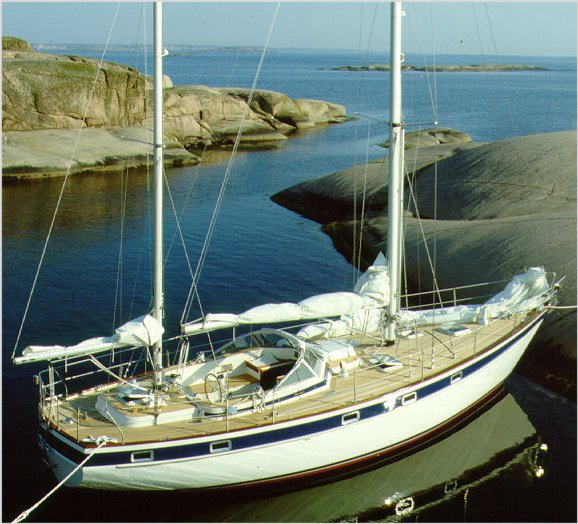
Hallberg-Rassy 42 (Enderlein)
Hallberg-Rassy |
37.2
moderate ocean |
12.93 m | 11,500 kg | 1980–1991 |
Olle Enderlein drew this centre-cockpit ketch for Hallberg-Rassy, and 252 were built between 1980 and 1991. At 11,500 kg on a 10.50 m waterline it is moderate-heavy rather than extreme (displacement/length about 277). Its Brewer comfort ratio is the highest on this list. The ketch rig splits the sail plan into smaller pieces that are easier to handle, which matters more than outright speed when two people stand all the watches. The skeg-hung rudder is better protected than a spade. |
|||||
| 2 |

Rustler 36
Orion Marine/ Rustler Yachts |
36.2
moderate ocean |
10.77 m | 7,623 kg | 1980 |
Kim Holman and Don Pye's long-keeled sloop dates from 1980, and it won the 2018 Golden Globe Race. Jean-Luc Van Den Heede sailed a 1990-built Rustler 36 solo and non-stop around the world in under 212 days, without electronic navigation. The numbers show why it suits that job: 7,623 kg displacement, a ballast ratio of about 45% and a capsize screening value of 1.72. The trade-off shows up in harbour. With the rudder hung on the keel, going astern is unpredictable, as the winner himself admitted. |
|||||
| 3 |

Valiant 40 (101-199)
Uniflite/Valiant Yachts |
35.8
moderate ocean |
12.17 m | 10,668 kg | 1973–1978 |
Bob Perry's 1973 double-ender is widely credited with creating the "performance cruiser": a cut-away fin keel and a skeg rudder at a time when ocean boats usually had full keels. It was elected to the American Sailboat Hall of Fame in 1997. A 10.36 m waterline on a 12.17 m hull lets it cover ground, and owners report regular 160-mile days. Check the hull number before you buy. Boats built from 1976 to 1981, roughly hulls 120–249, used a fire-retardant resin linked to severe blistering. |
|||||
| 4 |

Cape Dory 36
Cape Dory Yachts |
35.7
moderate ocean |
11.01 m | 7,303 kg | 1978–1990 |
One of Carl Alberg's later full-keel designs: a cutter built from 1978 to 1990, with 166 completed. It puts 7,303 kg on a short 8.23 m waterline with a 38% ballast ratio. That gives a displacement/length ratio near 365 and a gentle motion in a seaway, but with a sail area/displacement below 16 it needs wind to get going. The cutter rig lets you fly the staysail alone when the breeze builds. It's a traditional choice for sailors who value tracking and motion over speed. |
|||||
| 5 |
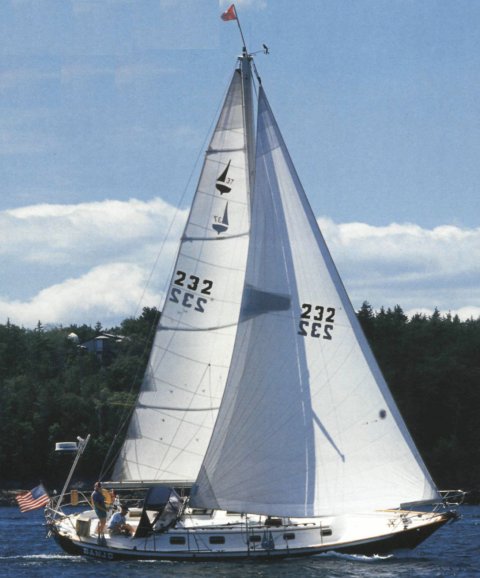
Pacific Seacraft 37
Cruising Consultants Inc. /Pacific Seacraft |
34.0
moderate ocean |
11.25 m | 7,257 kg | 1980 |
Bill Crealock's canoe-sterned cutter first appeared around 1980 and became one of the best-known American offshore designs of its time. The case for it rests on a fin keel with a skeg-protected rudder, 2,812 kg of ballast on 7,257 kg (39%), and a capsize screening value of 1.72. It's a compact 37, with only 8.46 m on the waterline, and the narrow canoe stern gives up some volume aft compared with a transom-sterned boat. Crealock also designed the Dana 24 and redrew the Westsail 32. |
|||||
| 6 |

Bristol Channel Cutter
Sam L. Morse Co./Cape George Marine Wrks. |
33.6
moderate ocean |
11.51 m | 6,350 kg | 1976 |
Lyle Hess based this cutter on 19th-century British pilot boats, and the Sam L. Morse Co. began building it in 1976. Hess also drew the Pardeys' Seraffyn and Taleisin, the boats behind their "go small, go now" books. It's 28 ft on deck but 11.51 m including bowsprit and boomkin, and it carries a big rig for a heavy boat (sail area/displacement about 18.5). One finished first overall in the 1978 Newport–Ensenada race. Another sailed from Dana Point to the Marquesas averaging 140 miles a day. |
|||||
| 7 |
32.9
moderate ocean |
16.00 m | 16,000 kg | 1999–2005 | |
Amel's 16 m ketch is designed as a complete system for a couple. It has electric furling and winches, a protected centre cockpit, and watertight bulkheads that divide the hull into sealed compartments. 241 were built between 1999 and 2005, and its 12.60 m waterline gives it real passage speed on a reach. Reviewers consistently note the same drawbacks: wide sheeting angles limit pointing, and the proprietary gear needs diligent, sometimes specialist, maintenance. Few boats this size are as easy for two people to run. |
|||||
| 8 |
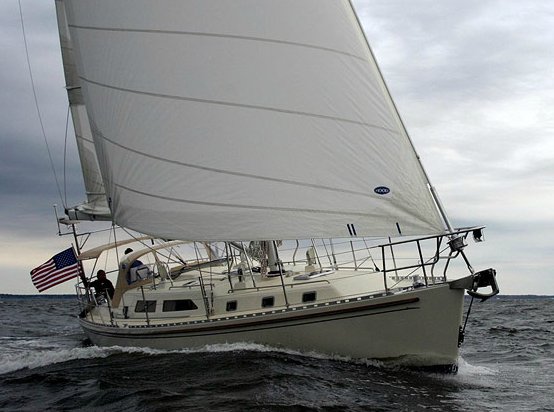
Outbound 44/46
Outbound Yachts |
32.5
moderate ocean |
13.64 m | 12,701 kg | 2001 |
Carl Schumacher, better known for fast West Coast designs such as the Express 27, drew this passagemaker, built by Outbound Yachts from 2001. Unlike most boats here it hangs its rudder on its own, without a skeg. Still, at 12,701 kg it's no lightweight, and the long 12.27 m waterline keeps its displacement/length ratio at a moderate 192. Reviewers praise the deep, safe cockpit, the big tankage and a light helm. One test logged low-to-mid seven knots in 20 knots of wind. |
|||||
| 9 |

Contessa 32
Rogers/UK, Taylor/Canada |
27.7
coastal cruiser |
9.75 m | 4,309 kg | 1971 |
David Sadler's 1971 design proved itself in the worst possible way. In the 1979 Fastnet storm the Contessa 32 Assent was the only boat in her class to finish. She was knocked down past horizontal and came back up. The numbers back that up: a 47% ballast ratio and a capsize screening value of 1.80. The cost is space. On a 7.32 m waterline and a 2.90 m beam it's narrow by modern standards, so it suits a crew of one or two who travel light. |
|||||
| 10 |

Boréal 47
Boréal |
25.2
coastal cruiser |
14.55 m | 10,290 kg | 2017 |
The modern answer to the same question. Jean-François Delvoye's aluminium cutter, built in Brittany, has a retractable centreboard, so it can sit upright on its keel box when the tide drops or reach shallow anchorages. A hard doghouse lets you keep watch out of the weather. 10,290 kg on an 11.63 m waterline gives a displacement/length ratio of 182, light for an ocean boat, and the highest sail area/displacement in this list (about 21.5). The aluminium hull is the main draw for high-latitude cruising. |
|||||

Methodology
Hand-picked by our editors, in editorial order. Brewer comfort ratio is shown for reference. Data as of 23 October 2026.
Hand-picked by our editors for a documented offshore record or a design built for ocean passages. Shown in order of Brewer comfort ratio, highest first; the rank is not a verdict. Ratios are calculated from the specifications on each boat page. Price, age and condition are deliberately not considered.
Ratios are calculated from the builders' published figures; see the sailing calculators for the formulas.