JPK 1030 vs JPK 1050
Specifications and performance ratios side by side.
Both of these JPK Composites boats are designed by Jacques Valer. The JPK 1030 was first built in 2019, and the JPK 1050, a scow-bowed racer-cruiser optimised for short-handed IRC racing, followed in 2025.
On paper the hulls are close in length: 10.34 m overall for the 1030 and 10.45 m for the 1050. The difference is in the shape. The newer boat is clearly beamier, at 3.54 m against 3.24 m, which goes with its scow bow.
The 1050 also goes deeper, with a T-keel drawing 2.22 m compared with 1.96 m on the 1030. Displacement is almost the same, 3,600 kg for the 1030 and 3,500 kg for the 1050. The 1030 carries 1,500 kg of ballast and can add optional water ballast in two 300-litre tanks.
For sails, the 1030 lists a reported area of 60 m², while the 1050 lists a 42 m² mainsail and 31 m² foretriangle. The 1030 also lists an 18 hp Volvo D1 diesel, 35 L of fuel and 80 L of water. The table below has all values.
On the numbers
Next to the JPK 1030, the JPK 1050 is 0.1 m longer and 3% lighter. The JPK 1050 has the higher Capsize screening (2.35, above the guideline), the JPK 1030 the lower (2.14, above the guideline).
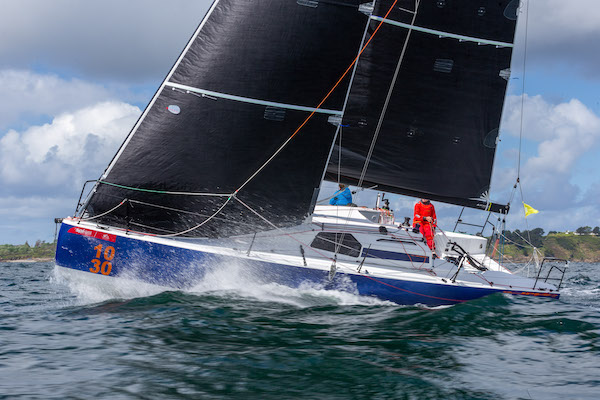 JPK 1030 |
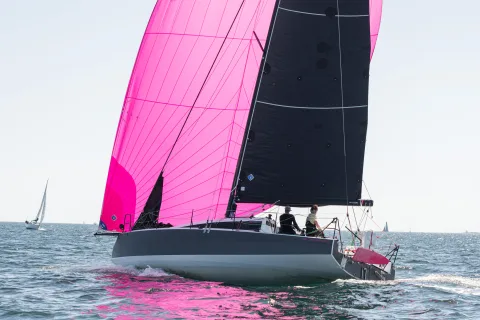 JPK 1050 |
|
|---|---|---|
| General | ||
| Builder | JPK Composites | JPK Composites |
| Designer | Jacques Valer | Jacques Valer |
| Hull type | Fin w/dual rudders | Monohull |
| Keel type | – | T-keel |
| Rigging | Fractional Sloop | – |
| Construction | GRP with vinylester infusion | – |
| First built | 2019 | – |
| Dimensions | ||
| Length overall | 10.34 m ▼ | 10.45 m ▲ |
| Waterline length | 9.05 m | – |
| Beam | 3.24 m ▼ | 3.54 m ▲ |
| Draft (max) | 1.96 m ▼ | 2.22 m ▲ |
| Headroom | 1.86 m | – |
| Weight & ballast | ||
| Displacement | 3,600 kg ▲ | 3,500 kg ▼ |
| Ballast | 1,500 kg | – |
| Ballast type | Lead | – |
| Sail plan | ||
| Sail area | – | 73.00 m² |
| Mainsail | – | 42.00 m² |
| Foresail | – | 31.00 m² |
| Engine & tanks | ||
| Engine make | Volvo | – |
| Engine power | 18 HP | – |
| Fuel | 35 L | – |
| Water | 80 L | – |
| Ratios | ||
| D/L | 135 light | – |
| Ballast/Disp | 41.7% high | – |
| Comfort ratio | 17.0 lightweight racing | – |
| Capsize screening | 2.14 ▼ above the guideline | 2.35 ▲ above the guideline |
| Hull speed | 7.30 kn | – |
▲ highest and ▼ lowest value in each row. Ratio bands as on the yacht pages; – means the value is not in the catalogue.
Last updated 26 October 2026